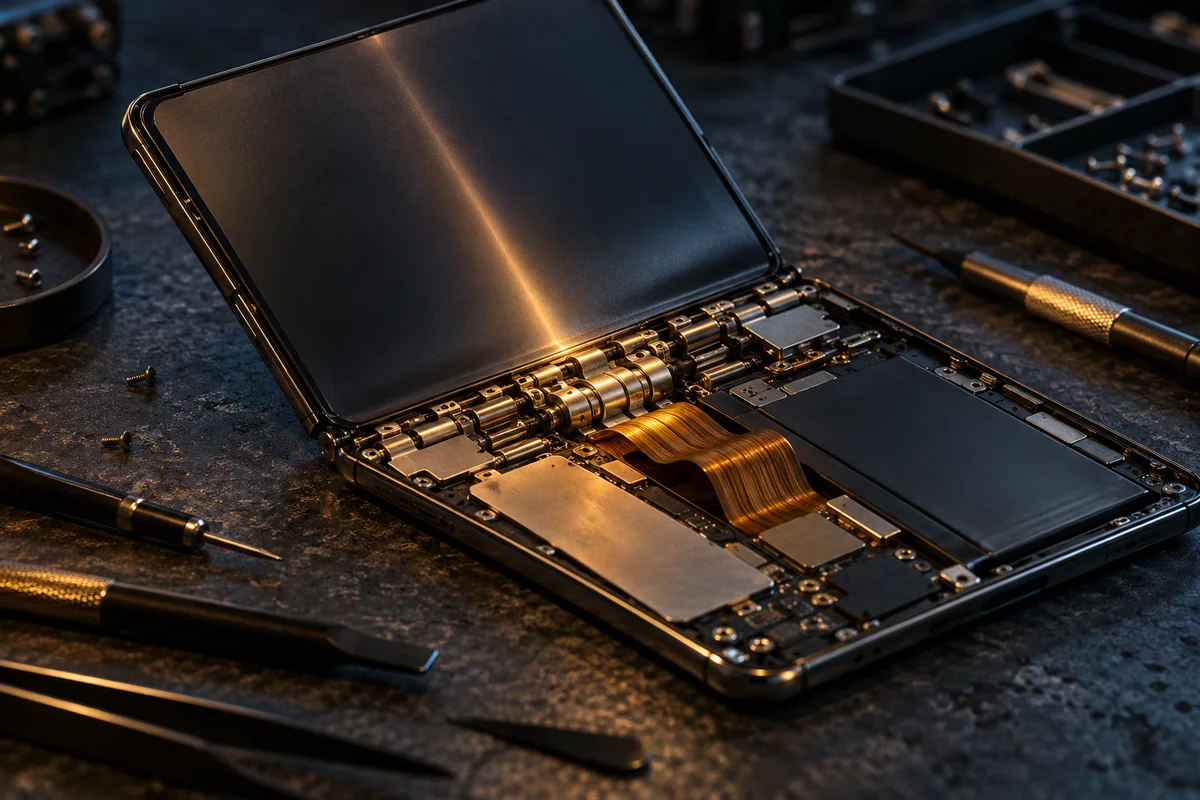


Apple opens the Ternus era with the $1,999 folding iPhone Duo
Apple unveiled its first folding iPhone on September 9, the $1,999 iPhone Duo, alongside the iPhone 18 Pro, the Watch Series 12 and Ultra 4, and the AirPods 5. Prices are up, and the rumour mill got almost everything wrong.

The “Surprise and Shine” keynote ran on Wednesday, September 9, 2026, at 10 a.m. Pacific. AppleInsider noted ahead of the event that this was the first presentation since the changing of the guard at the top: John Ternus took over from Tim Cook on September 1, and was set to carry this keynote from start to finish.
The folding one is called iPhone Duo
According to the wrap-up Macworld published once the conference ended, the device opens a 5.4-inch outer screen onto a 7.6-inch inner panel, with the same aspect ratio inside and out so your apps move between the two without missing a step. Stand it up and Standby mode turns it into a bedside clock; fold it halfway and the lower half becomes a virtual keyboard, laptop-style.
Inside: an A20 chip, a C2 modem, a dual 48 MP camera setup, and a 12 MP FaceTime camera fully under the display, a first on an iPhone. The price you pay for that is no Face ID: it’s Touch ID, built into the power button. The thing measures 5.2 mm open and 11.3 mm folded, claims IP68 dust resistance thanks to a hinge of more than a hundred components, and adds a nano-textured layer on the inner panel meant to hold off wear and the crease. Starting price: $1,999, pre-orders October 16, shipping October 23.
What the rumours were saying the day before
On September 4, MacRumors described an “iPhone Ultra” at 7.8 inches inside and 5.5 outside, 4.5 mm open and 9 mm folded, starting at $2,000 and climbing to $2,500 for the big storage tiers, powered by an A20 Pro chip with 12 GB of memory. AppleInsider, for its part, was betting on an “iPhone Fold” at 7.8 and 5.3 inches, with 18 MP front cameras.
So the name, both screen sizes, the thickness, the front sensor resolution and the entry price all differ from the product that actually got announced. Two things held up: Touch ID in place of Face ID, and no third lens. Worth noting that Macworld’s wrap-up calls the Duo’s chip an “A20”; the “Pro” suffix only ever turned up in the pre-keynote rumours.
The 18 Pro changes its price, not its face
The iPhone 18 Pro and Pro Max look like last year’s models. The headline addition is a variable aperture on the main 48 MP wide camera, adjusting incoming light on the fly in dim and harsh conditions alike. Four colours (Burgundy, light-blue Glacier, Silver, Black), and prices heading up: $1,199 for the Pro and $1,299 for the Pro Max at 256 GB, up to $2,499 for a 2 TB Pro Max. Pre-orders Saturday, delivery Friday, September 18. AppleInsider had called a $100-to-$300 increase and expected the variable aperture to stay a Pro Max exclusive: the increase showed up, the exclusivity didn’t.
Watches and earbuds
The Apple Watch Series 12 and Ultra 4 keep their silhouette and gain a Health Sensing System built on the S11 chip with new optical and electrical heart sensors, a Readiness app that cross-references recent activity, training load, vitals and a sleep score, longer battery life, a redesigned Health app, and two Apple Intelligence features: Siri Recap and Live Rewind, which replays the last fifteen seconds of a conversation. Budget $399 for the 42 mm Series 12, $449 for the 46 mm (against $429 before), and $799 for the Ultra 4.
The AirPods 5 stay at $129, but with active noise cancellation at that price — $50 less than the AirPods 4 that had it, and 50% better at damping noise according to Apple. Twenty dollars more gets you a wireless charging case and volume control on the stem. Shipping September 18 as well.
Apple spent ten years working out how to fold an iPhone. The one thing it was never going to fold on was the price.
Sources (3)
Written with AI assistance from the sources cited above, then reviewed and approved before publication by Sébastien Soulier.